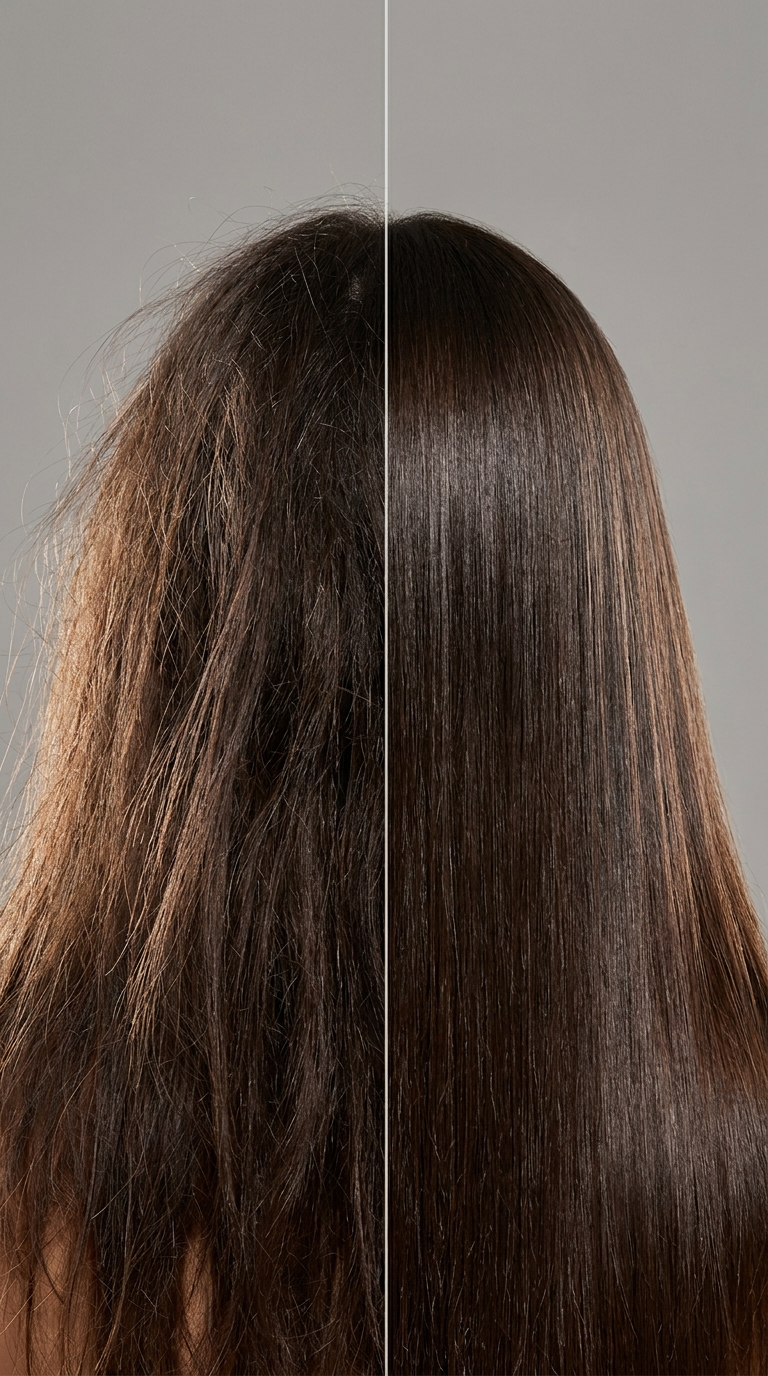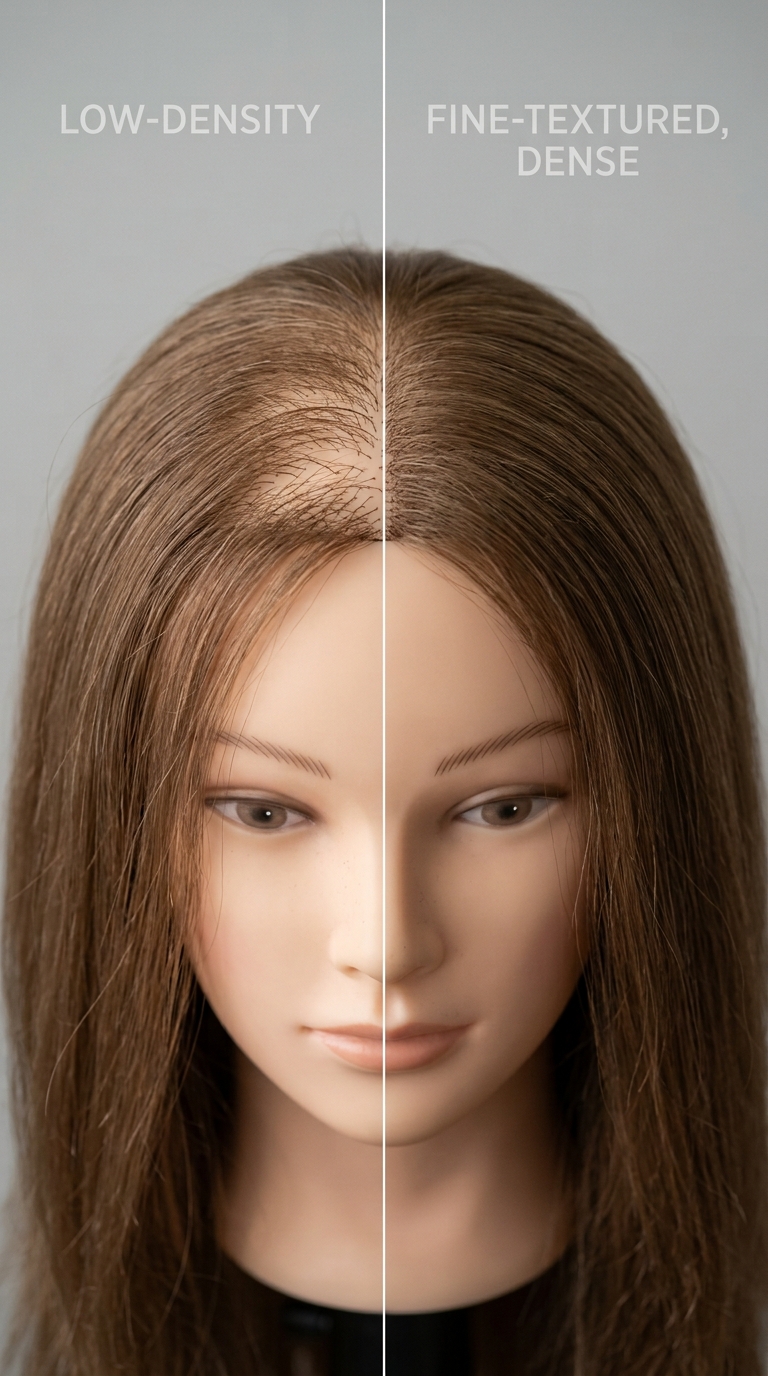
If you’ve ever grown out a bad haircut, you already know the feeling: hair seems to grow at the speed of continental drift. In reality, your hair is growing every single day — you just can’t see it happening.
On average, scalp hair grows about 0.5 inches (1.25 cm) per month, or roughly 6 inches (15 cm) per year. That’s the number you’ll see quoted everywhere. But it’s an average, not a rule. Your actual rate depends on genetics, age, hair type, hormones, and how well you’re treating your hair day to day.
This guide breaks down exactly how fast hair grows at every timescale, what speeds it up or slows it down, and — just as importantly — why growth rate isn’t the same thing as the length you actually end up keeping.
How Fast Does Hair Grow? The Numbers at a Glance
Here’s what that “half an inch a month” average looks like broken down by timeframe:
| Time Period | Average Growth | Range (Normal Variation) |
|---|---|---|
| Per day | 0.3–0.4 mm | 0.2–0.5 mm |
| Per week | 2–3 mm | 1.5–3.5 mm |
| Per month | 1–1.3 cm (≈0.5 in) | 0.6–1.7 cm |
| Per 6 months | 6–8 cm (≈2.5–3 in) | 4–10 cm |
| Per year | 12–15 cm (≈5–6 in) | 7–20 cm |
Daily growth is measured in fractions of a millimeter — about the thickness of a sheet of paper. That’s well below what the human eye can detect, which is exactly why hair growth feels invisible even though it’s constant. Fingernails grow at a comparable rate, but you notice them because the nail’s edge creates a visible line against your fingertip. Hair has no equivalent marker, so the progress hides in plain sight.
The Hair Growth Cycle: Why Hair Doesn’t Grow Forever
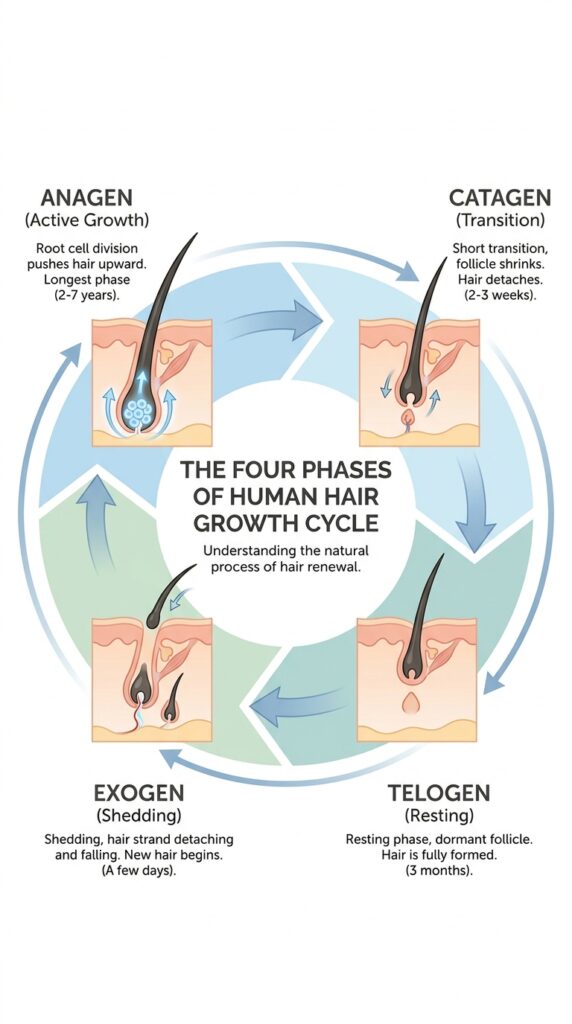
Hair doesn’t grow in one continuous, endless stretch. Each individual follicle runs through a repeating cycle with four distinct phases, and where a given hair sits in that cycle determines whether it’s actively lengthening, resting, or about to fall out.
- Anagen (growth phase): This is the active phase, when cells at the root divide rapidly and the hair shaft lengthens. It typically lasts 2 to 7 years, and its duration is almost entirely genetic — it’s what sets your maximum possible hair length. At any given moment, about 85–90% of your scalp hairs are in anagen.
- Catagen (transition phase): A short, roughly 10-day phase where growth stops, the follicle shrinks, and it detaches from its blood supply. Only about 1–3% of hairs are in catagen at once.
- Telogen (resting phase): The follicle stays dormant for about 1 to 4 months. No growth happens, but the hair usually remains in place while a new strand begins forming beneath it. Around 10–15% of your hair is in telogen at any time.
- Exogen (shedding phase): Often folded into telogen, this is when the old resting hair actually detaches and falls out, making room for the new anagen hair pushing up from below. Losing 50 to 100 hairs a day during this phase is completely normal, not a sign of hair loss.
Understanding this cycle explains a lot of hair behavior that otherwise seems confusing — why a haircut doesn’t “reset” your growth rate, why some people can grow hair to their waist while others plateau at shoulder length, and why hair shedding often shows up weeks or months after a stressful event rather than immediately.
How Fast Does Hair Grow by Hair Type and Ethnicity?

Hair growth rate isn’t identical across all hair types. Multiple studies — including research published in the British Journal of Dermatology and a 2016 study of more than 2,000 young adults — have measured real differences in average growth speed by hair type and ancestry.
| Hair Type / Background | Approx. Growth Rate | Approx. Yearly Length |
|---|---|---|
| Straight (commonly of East Asian background) | 1.3–1.4 cm/month | ~15–17 cm (6–6.7 in) |
| Wavy (commonly of European background) | 1.2 cm/month | ~14–15 cm (5.5–6 in) |
| Curly to coily (commonly of African background) | 0.8–1.0 cm/month | ~9–12 cm (3.5–4.7 in) |
A few important caveats make this table easy to misread:
- These are population averages, not individual guarantees. Plenty of people fall well outside their group’s typical range.
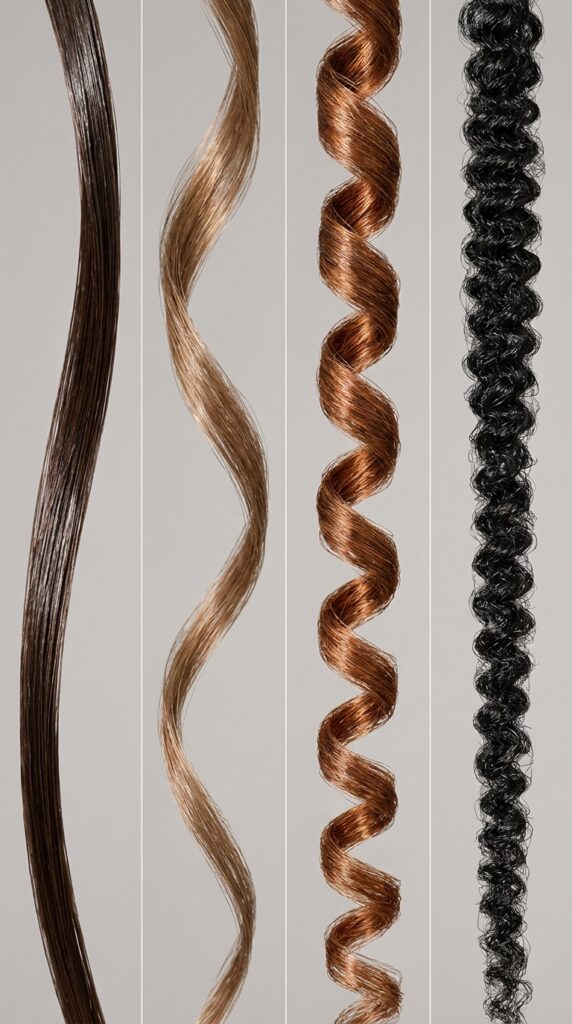
- Curlier, more tightly coiled hair often grows at a similar rate at the root but appears shorter because the curl pattern coils the strand back on itself — the hair is growing, it’s just not extending in a straight line the way straight hair does.
- Slower average growth doesn’t mean worse hair. Coily and curly hair types tend to be more resistant to certain kinds of breakage when properly moisturized, which can offset a slower growth rate over time — this is the growth-versus-retention distinction covered in detail below.
[Prompt 2 — Close-up comparison of straight, wavy, curly, and coily hair strand textures]
What Determines Your Personal Growth Rate

Genetics Sets Your Baseline
Genetics controls the length of your anagen phase, your terminal (maximum) hair length, and your general growth speed more than any other factor. If your parents or grandparents had a hard time growing hair past a certain length, you may be working with the same genetic ceiling — and no product changes that.
Age Changes Your Growth Speed
Hair growth isn’t constant across a lifetime:
- Childhood through the teens: Growth accelerates, often peaking around puberty.
- Ages 15–30: This is typically peak growth speed for most people.
- 30s and 40s: Growth gradually starts to slow.
- 50s and beyond: Growth continues to decelerate, anagen phases shorten, and hair often becomes finer. This is a normal part of aging, not automatically a medical problem.
Gender Plays a Role
On average, women’s hair grows very slightly faster than men’s on a day-to-day basis, but men’s hair often has a longer anagen phase, which is part of why men can grow extremely long hair despite a marginally slower daily rate. Hormones — particularly estrogen and androgens — are the main drivers behind this difference.
Season Has a Small but Measurable Effect
Hair tends to grow a little faster in warmer months. Higher temperatures increase blood flow to the scalp, which slightly boosts nutrient delivery to follicles. The effect is real but modest — don’t expect a dramatic summer growth spurt.
Health Factors That Slow Down Hair Growth
Your body allocates resources to vital organs first. Hair follicles are metabolically active but not essential to survival, so when something disrupts your health, hair is often one of the first places that shows it — usually with a delay of two to three months.
Nutritional Deficiencies
Hair is built almost entirely from a protein called keratin, so chronic under-eating or restrictive dieting can visibly slow growth and increase shedding. The nutrients most consistently linked to hair growth and hair loss in research are:
| Nutrient | Role in Hair Growth | Good Sources |
|---|---|---|
| Protein | Hair shaft is built from protein; deficiency directly reduces growth | Eggs, fish, poultry, legumes, Greek yogurt |
| Iron | Carries oxygen to hair follicles; low ferritin is strongly linked to shedding | Red meat, lentils, spinach, clams |
| Zinc | Supports follicle repair and oil gland function | Oysters, beef, pumpkin seeds, lentils |
| Vitamin D | Helps activate new follicle growth | Fatty fish, egg yolks, sun exposure |
| Vitamin C | Boosts iron absorption; supports collagen | Citrus, berries, bell peppers |
| Omega-3 fatty acids | Supports an anti-inflammatory scalp environment | Salmon, walnuts, flaxseed, chia seeds |
Biotin gets marketed heavily for hair growth, but true biotin deficiency is uncommon in people eating a varied diet — supplementing when you’re not actually deficient generally doesn’t move the needle, and high-dose biotin can even skew certain thyroid lab results. The most evidence-backed approach is to correct an actual, tested deficiency rather than stacking supplements speculatively.
Chronic Stress
Sustained high cortisol can push a larger-than-normal share of hairs out of anagen and into the resting telogen phase. This condition, known as telogen effluvium, doesn’t show up immediately — the extra shedding typically appears two to three months after the stressful period, which is why people are often confused about what “caused” a sudden bout of hair loss.
Hormonal Shifts
- Pregnancy often extends the anagen phase, which is why hair can look noticeably thicker during pregnancy — followed by a shedding phase (postpartum telogen effluvium) a few months after delivery as those hairs enter telogen together.
- Menopause and declining estrogen typically slow growth and can make hair finer.
- Thyroid disorders — both hypothyroidism and hyperthyroidism — commonly disrupt the growth cycle.
- Hormonal birth control can help or hurt hair growth depending on the specific formulation and the individual.
Underlying Medical Conditions
Autoimmune conditions such as alopecia areata attack hair follicles directly. Scalp conditions like psoriasis or seborrheic dermatitis can disrupt the follicle environment. These situations generally need a dermatologist rather than an over-the-counter fix.
Your Hair Growth Timeline: What to Realistically Expect
Setting the right expectations up front saves a lot of frustration. Here’s roughly what happens at each milestone, assuming average growth and minimal breakage:
- 1 month: About 1–1.3 cm of new length. It’s essentially invisible to the eye and to a camera.
- 3 months: Roughly 3–4 cm total. This is usually the point where people first notice a difference, especially if hair had been thinning — new hairs re-entering anagen after a rest phase start to add visible density.
- 6 months: Around 6–8 cm. The change is now obvious in side-by-side photos, and split ends from the previous length may need their first trim.
- 1 year: Roughly 12–15 cm (5–6 inches). That’s typically enough to take chin-length hair to the shoulders, or shoulder-length hair to mid-back — assuming you aren’t losing length to breakage along the way.
- 2 years: Roughly 24–30 cm, again assuming minimal breakage and a supportive hair-care routine.
Curly and coily hair types often show less visible length change at the same milestones, purely because the coil pattern compresses the strand — the growth is happening at a comparable rate, it just doesn’t read the same way to the eye.
Growth Rate vs. Length Retention: The Distinction That Changes Everything
This is the single most misunderstood part of hair growth, and it’s worth its own section.
Growth happens at the root. It’s a biological process you have very limited control over.
Retention is how much of that new growth you actually get to keep, measured from root to end. It’s governed almost entirely by how much breakage and damage happens along the hair shaft — not by how fast new hair is coming in.
Here’s why that matters: someone with a slower genetic growth rate but excellent retention (minimal breakage, gentle handling, regular trims to catch splits early) will often end up with longer hair than someone with fast genetic growth but heavy heat styling, chemical damage, or mechanical stress from tight hairstyles.
In other words, if your hair “isn’t growing,” the more likely explanation in most cases isn’t that your roots have stopped working — it’s that your ends are breaking off roughly as fast as new length comes in. Fixing retention is usually a faster win than trying to speed up growth itself.
Common retention killers to watch for:
- Heat styling without heat protectant
- Over-brushing, especially when hair is wet and most fragile
- Tight ponytails, buns, or braids pulling at the same spots repeatedly
- Chemical over-processing (bleach, relaxers, frequent coloring)
- Rough towel-drying instead of blotting or microfiber
- Skipping trims until splits travel up the shaft
How to Measure Your Own Hair Growth Rate
Averages are useful, but your personal rate is what actually matters. These four methods let you find it:
- The root-color test. If you color your hair, measure the visible regrowth at the root after exactly two weeks, then divide that measurement by 14 to get your daily rate. This is one of the more precise DIY methods since the color line gives you a sharp, fixed reference point.
- Monthly comparison photos. Take a photo in the same spot, same lighting, same angle, once a month. Wearing a top with a fixed pattern or logo gives you a visual anchor to compare against. Photos catch changes your daily mirror-check misses entirely.
- The fixed-strand measurement. Pick one section of hair, mark a reference point on your scalp (a part line works well), and measure that same strand with a soft tape measure on the same day each month for at least three to six months to get a reliable average.
- The ponytail-circumference test. Wrap a hair tie around your ponytail at the same tension each month and note where it lands. A shrinking circumference at the same length suggests thickening or increasing density, which is a useful complement to pure length tracking.
Can You Actually Make Hair Grow Faster?
Here’s the honest answer: you cannot push your hair past its genetic maximum rate. No shampoo, serum, or supplement changes how fast follicle cells divide if you aren’t deficient in something to begin with. What you can do is remove the things that are actively holding growth back and support the healthiest possible environment for the follicles you have.
[Prompt 3 — Person performing a scalp massage as part of a healthy hair-care routine]
What Genuinely Helps
- Eating enough protein and correcting real deficiencies (iron, vitamin D, zinc) — ideally confirmed with a blood test rather than guessed at.
- Scalp massage. Small clinical studies have found that consistent scalp massage (a few minutes daily) can increase hair thickness and hair count over time, likely by mechanically stimulating the cells at the base of the follicle. The effect on growth speed itself is modest, but it’s a low-risk habit worth keeping.
- Managing chronic stress through sleep, exercise, or whatever genuinely reduces your cortisol load.
- Trimming split ends before they travel up the shaft, which protects retention even though it doesn’t affect root-level growth.
- Gentle handling: detangling from the ends up, using a wide-tooth comb on wet hair, and reducing tension-heavy styles.
What Generally Doesn’t Help
- Most “hair growth” shampoos and conditioners — they rinse off before they could ever reach the follicle, which sits below the skin’s surface.
- Biotin supplementation, unless you have a confirmed deficiency.
- Frequent washing — it affects the hair shaft, not the root, and won’t slow or speed growth either way.
- Overnight or “miracle” treatments promising dramatically faster growth in days or weeks — no topical product can outpace your biology that quickly.
The One Exception With Real Clinical Backing
Minoxidil (commonly sold as Rogaine) is the one over-the-counter option with solid clinical evidence behind it. It can meaningfully extend the anagen phase and, in many users, increase growth speed and follicle activity. Results vary by individual, take several months to appear, and reverse if you stop using it. It’s worth a conversation with a doctor or dermatologist before starting, especially to rule out other causes of shedding first.
Common Mistakes That Sabotage Hair Growth
Even with a solid routine, small habits quietly cancel out progress. Watch for these:
- Chasing growth while ignoring retention. Buying growth serums while still flat-ironing daily is treating the wrong side of the equation.
- Over-supplementing without testing. Megadosing biotin or other vitamins you aren’t deficient in wastes money and can distort lab results if you ever do get tested.
- Switching products every few weeks. Hair-care changes take 8–12 weeks (roughly one full telogen-to-anagen cycle for shed hairs) to show real results — constant switching means you never see whether anything actually worked.
- Skipping trims entirely to “save length.” Ironically, this often costs more length overall, since untrimmed splits keep climbing the shaft.
- Judging progress week to week. At 0.3–0.4 mm a day, weekly checks will almost never show a visible difference and mostly just create frustration. Track monthly instead.
- Assuming all shedding is hair loss. Losing 50–100 hairs a day is the normal output of the telogen-exogen phase, not a sign anything is wrong.
Medications and Medical Treatments That Affect Hair Growth
Certain drugs and treatments interfere with the hair cycle directly:
- Chemotherapy targets rapidly dividing cells throughout the body, and hair follicles are among the fastest-dividing cells we have, which is why hair loss is such a common side effect. Growth almost always resumes after treatment ends, though the new hair sometimes comes in with a different texture or color — a change that can be permanent.
- Blood thinners are linked to increased shedding in some patients.
- Certain antidepressants can trigger telogen effluvium as a side effect.
- Isotretinoin and other acne medications can affect hair and skin turnover.
- Hormonal birth control, when started or stopped, can trigger a temporary shedding phase as hormone levels shift.
If you start a new prescription and notice increased shedding a few months later, it’s worth checking the medication’s side-effect profile and mentioning it to your prescribing doctor rather than stopping the medication on your own.
When to See a Doctor About Hair Growth
[Prompt 4 — Dermatologist consultation examining a patient’s scalp and hair]
Most slow growth is normal variation, not a medical issue — but a few signs are worth getting checked out:
- Hair that barely grows at all, or growth that has clearly slowed within the last two to three months
- Shedding that’s noticeably heavier than your normal baseline
- Visible bald or thinning patches, especially with a defined shape or border
- Scalp itching, redness, flaking, or pain alongside hair changes
- Hair loss following a major illness, surgery, rapid weight change, or new medication
A dermatologist can run bloodwork covering iron/ferritin, thyroid function, vitamin D, and zinc, plus examine the scalp directly if a condition like alopecia areata or a fungal infection is suspected. The encouraging part: most causes of unusually slow growth — deficiencies, hormone imbalances, thyroid issues — are treatable, and hair typically returns to its normal rate within about six months once the underlying cause is addressed.
Frequently Asked Questions
How much does hair grow in a week?
About 2–3 millimeters on average — far too little to notice with the naked eye, which is why weekly progress checks tend to feel discouraging even when growth is perfectly normal.
Does cutting hair make it grow faster?
No. Trimming removes length from the ends; it has no effect on the follicle at the root, which is where growth actually happens. Regular trims help you keep more length by removing splits before they travel upward, which can make growth more noticeable, but they don’t speed up the biological growth rate itself.
Why does my hair seem to have stopped growing?
In most cases it hasn’t — you’re losing length to breakage at roughly the same rate new hair is coming in, so the net length stays flat. This is the growth-versus-retention issue covered above, and it’s far more common than a genuine growth-rate problem.
Can stress really cause hair loss?
Yes. Significant physical or emotional stress can push a larger share of hairs into the resting (telogen) phase, leading to increased shedding roughly two to three months later. This is usually temporary once the stressor resolves.
Does hair grow faster while you sleep?
Not meaningfully. Growth is continuous and doesn’t spike overnight; any perceived difference is more likely related to circadian patterns in scalp blood flow, which are minor compared to the other factors covered here.
Is it true that Asian hair grows the fastest?
On average, yes — several studies have found straight, commonly East Asian hair types growing slightly faster than wavy or curly types. But this is a population-level average with wide individual variation, not a rule for any one person.
Final Thoughts
The core number is simple: hair grows about half an inch a month, or roughly six inches a year, and that rate is set mostly by genetics you can’t override. What you can control is everything downstream of the root — nutrition, stress, gentle handling, and protecting your ends from breakage.
If you want to actually see longer hair, the highest-leverage move usually isn’t chasing a faster growth rate. It’s making sure the length you’re already growing doesn’t snap off before it gets the chance to show. Take a dated photo today, check your nutrition and stress levels honestly, tighten up your retention habits, and reassess in three months — that’s usually where the real difference becomes visible.